

Flush Mount (Hugger) vs Downrod Ceiling Fans: Airflow CFM Differences
Choosing between a flush mount (hugger) vs downrod ceiling fans involves more than just aesthetics; it fundamentally changes how your room feels. While many homeowners prioritize the sleek, compact look of a hugger unit, the physical distance between the blades and the ceiling significantly impacts air movement.
Understanding the airflow CFM differences between these two mounting styles helps you avoid the common mistake of installing a fan that looks great but fails to cool your space effectively. By examining how blade proximity affects intake and circulation, you can make an informed decision that balances your interior design preferences with the practical performance needs of your living area.
The primary difference in performance stems from the “blade-to-ceiling gap,” which directly dictates how much air the fan can displace. A downrod mount ceiling fan is almost always superior in terms of pure CFM (Cubic Feet per Minute) output because it creates the necessary clearance for air to be drawn into the blade span. When a fan sits too close to the ceiling, the blades struggle to pull air from above, essentially starving the motor of its intake.
This restriction leads to lower overall air circulation, even if the motor itself is identical to a downrod-mounted counterpart. For maximum cooling efficiency in larger rooms, the downrod remains the industry standard.
Understanding the Mechanics of Airflow Efficiency

Air circulation is a result of fluid dynamics, and ceiling fans rely on a clear path for air to enter the blade radius. When you use a downrod, you move the fan blades away from the ceiling surface, allowing air to flow freely from above and behind the blades.
This intake is crucial for generating the pressure differential required to push air downward into your living space. Without this distance, the fan blades are essentially “choking” on stagnant air trapped between the housing and the ceiling.
Flush mount fans, often called huggers, are designed to sit close to the ceiling for aesthetic reasons or to accommodate low ceilings. While modern engineering has improved their performance, they cannot overcome the laws of physics that govern intake volume.
The limited space between the ceiling and the blades creates a high-pressure zone that resists the downward flow of air. Consequently, even a high-quality motor in a hugger fan will often record lower CFM numbers than a downrod model of similar size and blade pitch.
Evaluating CFM Ratings and Performance Metrics

When shopping for a new fixture, you will see a CFM rating on the packaging, which stands for Cubic Feet per Minute. This measurement represents the volume of air moved by the fan at its highest speed setting.
A higher number indicates more effective air movement, which translates to better cooling in your room. Comparing these numbers is the most reliable way to gauge performance, but you must look at the mounting method to understand why those numbers vary.
Manufacturers often list different CFM ratings for the same motor assembly depending on whether it is installed with a flush mount or a downrod. You might notice the same fan model loses 10% to 20% of its total CFM output when installed as a flush mount.
This drop is entirely due to the airflow restriction caused by the proximity to the ceiling. Always check the manufacturer’s technical specifications sheet, which often breaks down performance data by installation type.
The Role of Ceiling Height in Your Selection
Your ceiling height is the most critical constraint when choosing between these two styles. Standard residential ceilings are typically 8 to 9 feet high, which is the “danger zone” for downrod fans.
Installing a long downrod in a room with an 8-foot ceiling can create a safety hazard and an visual obstruction. For these lower spaces, a flush mount is often the only practical choice, even if it sacrifices some peak airflow efficiency.
If your ceilings are 10 feet or higher, you should almost exclusively use a downrod. High ceilings allow the fan to hang at an optimal level, usually 8 to 9 feet from the floor, which is the sweet spot for human comfort. Using a flush mount in a high-ceilinged room is counterproductive because the air movement will be trapped near the ceiling where it does little to cool people in the room.
You can find detailed guidance on recommended mounting heights through resources like the U.S. Department of Energy guidelines on home cooling.
Comparing Mounting Styles for Different Room Types

The function of the room should dictate your choice as much as the ceiling height. In a bedroom where you might want a gentle breeze, a flush mount fan is often sufficient and creates a cleaner, less cluttered look.
In a larger living room or a high-traffic kitchen, you need the higher airflow capacity provided by a downrod. The following table highlights the general performance and usage differences between these two common mounting configurations.
| Feature | Flush Mount (Hugger) | Downrod Mount |
|---|---|---|
| Primary Benefit | Low profile, safety | Maximum airflow |
| Ceiling Height | Best for 8ft or lower | Best for 9ft or higher |
| Airflow Efficiency | Moderate to Low | High |
| Visual Impact | Subtle, minimalist | Architectural, prominent |
| Intake Capability | Restricted | Optimal |
Addressing the Aesthetic vs Performance Trade-off
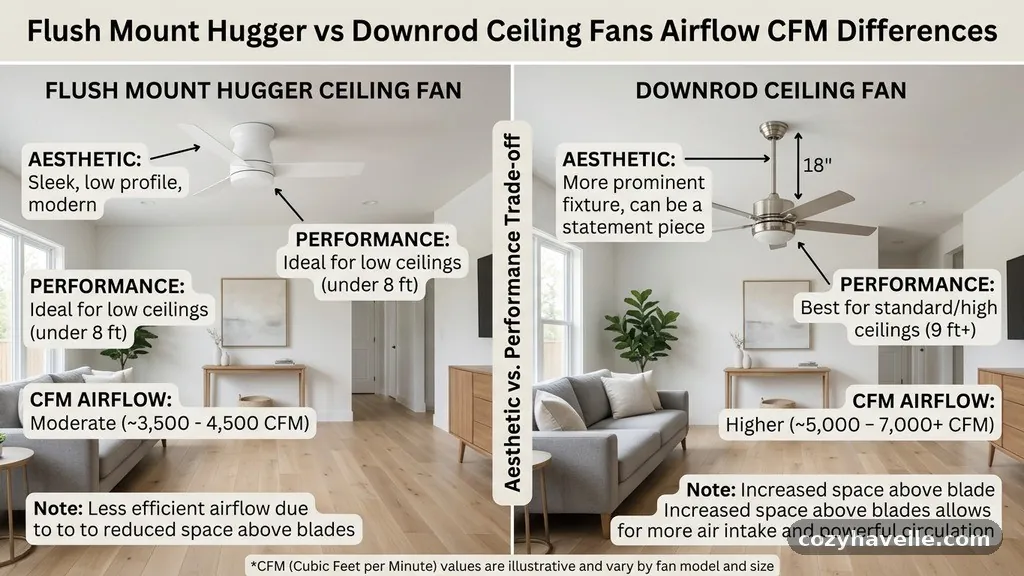
Homeowners frequently struggle with the conflict between interior design goals and functional cooling requirements. A flush mount fan is popular because it doesn’t interrupt the sightlines of a room, making it ideal for minimalist or modern decor.
However, if your primary goal is to lower the ambient temperature in a hot climate, the performance loss is a significant factor. You must weigh whether the visual benefit of a hugger fan outweighs the necessity of a more powerful, downrod-mounted unit.
There are ways to mitigate the performance gap if you are forced to use a flush mount due to low ceilings. Look for models with wider blade spans or steeper blade pitches, which can help compensate for the restricted intake.
Some manufacturers also offer “semi-flush” options that provide a small amount of space between the ceiling and the blades. This tiny gap can make a measurable difference in air circulation without requiring the full length of a standard downrod.
Installation Considerations and Potential Challenges
The installation process for these two types of fans differs significantly, which can affect your total project cost. Downrod fans require a specific mounting bracket that allows for a “ball-and-socket” connection, which provides stability and allows the fan to hang level even on angled ceilings.
Flush mount fans attach directly to the ceiling box, which can be more difficult if the wiring or mounting box is not perfectly level. If your ceiling box is recessed, you may need additional hardware to ensure a secure fit for a hugger fan.
When installing a downrod fan, you must also select the correct length of the rod to ensure the blades are at the right height. Most manufacturers include a short 3-inch or 4-inch downrod, but you may need to purchase a longer one for vaulted or high ceilings.
Always ensure that the downrod is compatible with your specific fan model to prevent wobbling or noise issues. A poorly installed downrod can cause the fan to oscillate, which not only looks bad but can eventually damage the motor housing.
The Impact of Blade Design on Air Circulation

Beyond the mounting style, the shape and number of blades play a vital role in how effectively a fan moves air. A fan with five blades might move air differently than a three-blade fan, even if the CFM rating is similar.
Generally, blades with a more aggressive pitch (the angle of the blade relative to the ceiling) move more air but can also create more wind noise. If you choose a hugger fan, selecting a model with a higher blade pitch can help pull more air despite the restricted intake space.
Material choices also matter, as rigid blades tend to hold their shape better and move air more consistently than flexible or plastic blades. In a flush mount setup, you want the most efficient blade design possible to counteract the inherent limitations of the mounting style.
Look for aerodynamic blade profiles that are designed to scoop and push air effectively. These premium blade designs can make a noticeable difference in the overall cooling sensation in your room.
When to Choose a Smart Fan for Better Control
Modern ceiling fans often include “smart” features that can help manage airflow more effectively. These fans can be integrated into home automation systems, allowing you to set schedules or adjust speeds based on the temperature in the room.
While this does not change the physical limitations of flush mount vs downrod airflow, it does allow you to optimize the fan’s usage. For instance, you can set the fan to run at high speeds only when the room is occupied, effectively managing the cooling efficiency of a smaller hugger unit.
Smart fans also often feature high-efficiency DC motors, which are much quieter and more energy-efficient than traditional AC motors. These motors can maintain consistent RPMs even under the slight load of a restrictive flush mount installation.
If you are limited by ceiling height but need better performance, a smart fan with a high-torque DC motor is a smart investment. It won’t change the physics of the airflow, but it will ensure that you get the maximum possible output from the space you have.
Common Questions Regarding Ceiling Fan Performance
Which type of ceiling fan is better for large rooms?
For large rooms, a downrod-mounted ceiling fan is almost always the better choice. Large spaces require a greater volume of air to be moved to create a noticeable cooling effect, and the unobstructed intake of a downrod allows the fan to reach its full rated CFM potential.
Can I convert a downrod fan to a flush mount?
Most ceiling fans are designed specifically for one type of installation or the other. While some models are “dual-mount,” meaning they can be installed with or without a downrod, you should never attempt to modify a dedicated downrod fan into a flush mount. This can void your warranty and create a safety risk due to improper motor ventilation.
Do flush mount fans move less air than downrod fans?
Yes, generally speaking, flush mount fans move less air than downrod fans with similar motors. Because the blades are positioned very close to the ceiling, they cannot draw in as much air, which limits the total volume of air they can push into the room.
At what ceiling height should I switch from a hugger to a downrod?
The general industry recommendation is to use a flush mount (hugger) for ceilings that are 8 feet or lower. Once you reach 9 feet or higher, a downrod is recommended to bring the fan into the effective cooling zone and ensure the blades have enough room to pull air efficiently.
Does the number of blades affect the CFM rating?
The number of blades is less important than the overall design, blade pitch, and motor power. A three-blade fan can move just as much air as a five-blade fan if it is designed for efficiency. CFM ratings are the most reliable indicator of performance, regardless of how many blades are attached to the motor.
Final Thoughts on Optimising Your Ceiling Fan Choice
Selecting the right mounting style for your ceiling fan is a balance between the physical requirements of your room and your personal aesthetic vision. While the flush mount (hugger) offers a sleek, unobtrusive look perfect for lower ceilings, the downrod mount provides the essential clearance needed for maximum air circulation and cooling power. By understanding the airflow CFM differences and the impact of blade proximity, you can ensure your home stays comfortable throughout the warmer months.
Before making your final purchase, measure your ceiling height and verify the manufacturer’s technical specifications for your preferred model. If you have the vertical space, choosing a downrod will almost always yield better performance results. If you are limited to a flush mount, look for high-torque motors and well-engineered blades to compensate for the mounting restriction.
We hope this breakdown helps you select a fan that keeps your space comfortable and stylish for years to come. Feel free to reach out if you need help calculating the right fan size for your specific room dimensions.