
Can You Hang a Ceiling Fan from a Regular Plastic Light Fixture Box?
Determining whether you can hang a ceiling fan from a regular plastic light fixture box is a critical safety decision for any homeowner. Standard electrical boxes designed for simple light fixtures are not built to handle the dynamic weight and constant vibration of a spinning fan.
If you attempt to mount a fan to an unrated box, you risk the unit detaching from the ceiling and causing significant injury or property damage. This article explains why standard boxes fail and provides the necessary steps to ensure your installation is secure and compliant with electrical safety standards.
Why Standard Plastic Boxes Are Not Suitable
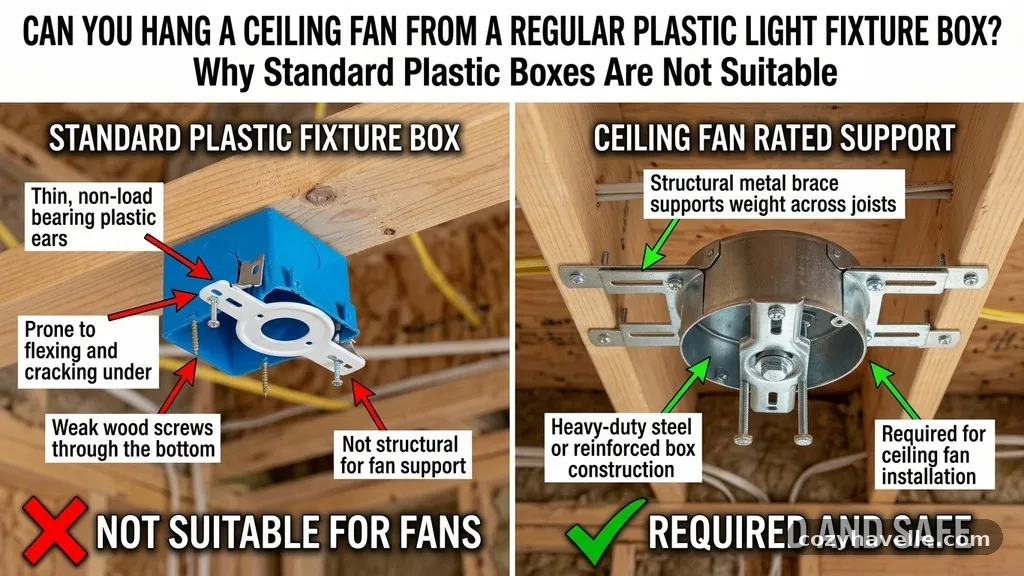
Most light fixture boxes found in residential ceilings are made of lightweight plastic or thin-walled metal. These boxes are designed strictly to hold the weight of a stationary pendant light or a flush-mount fixture, usually weighing less than 10 pounds. A ceiling fan, by contrast, introduces two major stressors: dead weight and torque.
Dead weight refers to the actual mass of the motor, blades, and light kit. Many modern fans weigh between 15 and 30 pounds, which far exceeds the load capacity of a standard junction box.
When the motor spins, it creates rotational force that vibrates the entire housing. These vibrations can cause plastic mounting ears to crack or snap, leading to a catastrophic failure of the fixture.
Safety standards mandated by the National Electrical Code (NEC) require that any box supporting a ceiling fan must be specifically marked as “fan-rated.” These boxes are constructed with reinforced materials and heavy-duty mounting hardware designed to resist the fatigue caused by oscillation.
Using a standard box for a fan is a clear violation of these safety protocols. You should never assume that a pre-existing box has the structural integrity required for a fan, regardless of how sturdy it feels when you pull on it.
Understanding Fan-Rated Junction Boxes

A fan-rated box is engineered to handle both the weight and the movement associated with ceiling fans. Manufacturers typically stamp these boxes with a clear rating stating they are suitable for fan support. This is the only way to confirm that the box has been tested to meet the necessary safety thresholds.
These boxes often come with specialized mounting screws that are thicker and longer than those used for standard light fixtures. The internal structure is also reinforced, often utilizing metal components or high-density polymers that do not become brittle over time. When you shop for these items, you will see specific weight ratings listed on the packaging.
Most residential fan-rated boxes are rated for up to 70 pounds, which covers almost every consumer-grade fan on the market. If you are installing a heavy-duty or industrial-sized fan, you must double-check the rating to ensure it meets the manufacturer’s requirements. Never substitute a standard light box for a fan-rated one, even if you think the fan is lightweight.
The Role of Joists and Braces
The box itself is only half of the equation; the way it attaches to your home’s structure is equally important. A standard plastic box is often nailed directly into a wooden joist or suspended via a simple plastic bracket. These methods are insufficient for the forces generated by a ceiling fan.
If your current box is positioned directly against a wooden ceiling joist, you might be able to use a fan-rated box that screws directly into the joist. However, if the box is located between joists, you need a specialized support system. This is where a ceiling fan brace becomes essential.
A fan brace is a telescoping metal bar that expands between two ceiling joists. It locks into place and provides a solid, steel foundation for the fan-rated box. This setup distributes the weight of the fan across the structural frame of the house rather than relying on the drywall or a weak plastic mount.
Common Risks of Improper Installation

Ignoring the requirement for a fan-rated box leads to several dangerous outcomes. The most immediate risk is the fan falling from the ceiling while in operation. This can occur suddenly, especially if the vibrations have slowly loosened the mounting screws over time.
Beyond the risk of the fan falling, improper mounting can cause damage to the surrounding ceiling drywall. As the fan wobbles, the torque transfers to the box, which then pushes against the drywall.
This often leads to spiderweb cracking around the fixture. Over time, the hole in the ceiling may widen, making it impossible for the box to stay securely in place.
Electrical hazards are also a significant concern. If the box shifts or breaks, it can pull on the wiring connections inside.
This may cause loose wires, arcing, or even a short circuit that trips your breaker. In worst-case scenarios, the friction caused by loose, sparking wires inside a damaged plastic box can lead to an electrical fire.
How to Identify Your Current Box
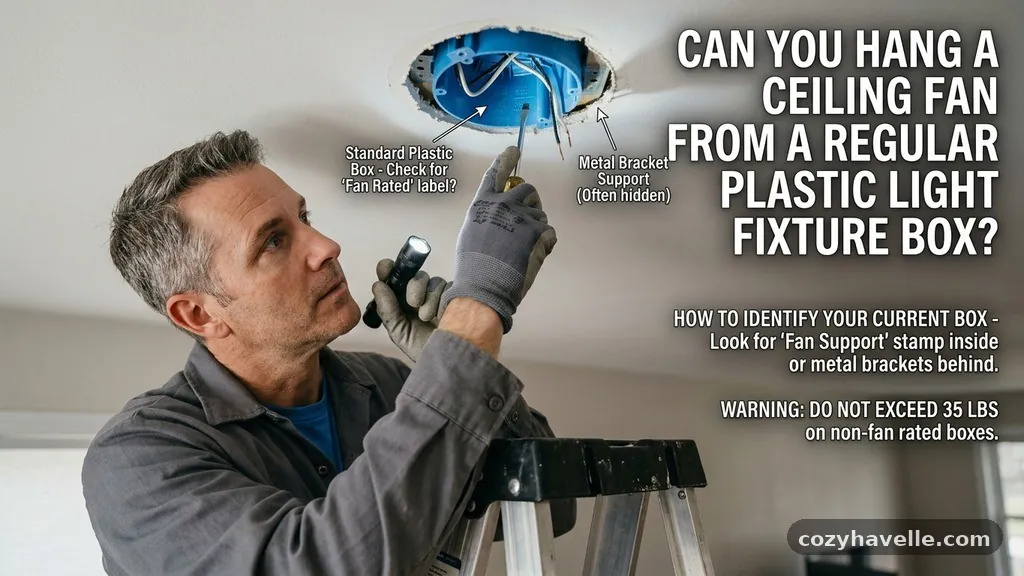
Before you commit to a new project, you need to inspect the existing box. Turn off the power at the main breaker panel before removing the current light fixture. Once the fixture is down, look for any markings inside the box.
Fan-rated boxes almost always have clear, embossed text indicating their capacity. Look for phrases like “Acceptable for Fan Support” or “Fan Rated.” If you see no markings, or if the box is made of thin plastic with small, flimsy mounting ears, it is not safe to use for a fan.
You can also test the mounting method. If the box is held up by a thin plastic bracket that flexes when you apply pressure, it is definitely not for fans.
A professional-grade fan installation requires a rigid, immovable connection. If you are uncertain about the age or rating of your box, the safest path is to remove it and install a new fan-rated box.
Steps to Replace a Non-Rated Box
Replacing a standard box with a fan-rated model is a manageable task, provided you have the right tools. You will need a screwdriver, a drill, a voltage tester, and potentially a saw to enlarge the hole if the new box is larger. Always verify the power is off using a non-contact voltage tester before touching any wires.
1. Remove the existing light fixture and the old box.
2. Inspect the area to determine if you are near a joist.
3.
If you are between joists, install a fan brace by pushing it through the hole and rotating it until it bites into the wood.
4. Secure the new fan-rated box to the brace or the joist according to the manufacturer’s instructions.
5. Re-run the wiring through the new box and secure the cables with the provided clamps.
Ensuring that the box is tightly secured to the structural framing is the most important part of the process. Even a fan-rated box will be dangerous if it is loosely mounted to the ceiling material. Take your time to ensure the installation is rock-solid.
Comparison of Box Types
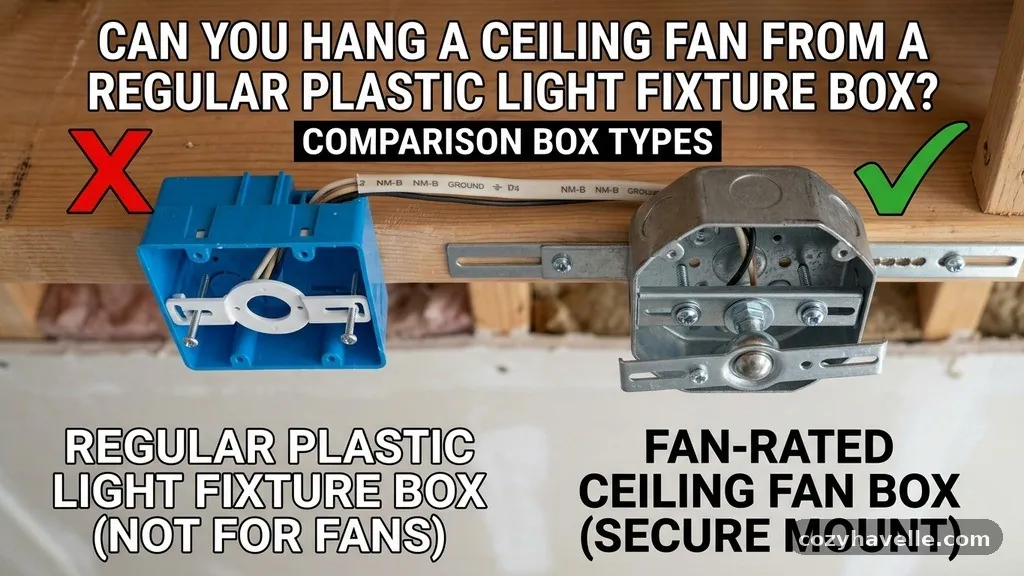
Understanding the differences between standard and specialized electrical boxes helps clarify why one is safe and the other is not.
| Feature | Standard Light Box | Fan-Rated Box |
|---|---|---|
| Primary Purpose | Stationary lighting | Dynamic loads (fans) |
| Material | Thin plastic or light metal | Heavy-duty steel or reinforced polymer |
| Mounting Method | Nails or light brackets | Bolts to joists or heavy-duty braces |
| Weight Capacity | Typically under 10 lbs | Up to 70 lbs or more |
This table highlights the clear disparity in construction and intended use. While a standard box might look similar to a fan-rated one from a distance, the internal mechanics are vastly different. Relying on a standard box for a fan is a gamble with your home’s safety.
When to Hire a Professional Electrician
While many homeowners are comfortable with basic electrical work, installing a fan-rated box can be complex. If you have to access the attic to install a brace, or if your ceiling is made of plaster rather than drywall, the job becomes much more difficult. Plaster is prone to cracking and can be difficult to patch if you make a mistake.
Furthermore, if your home has older wiring, such as knob-and-tube or ungrounded wiring, you should consult an electrician. Adding a heavy electrical load to an old circuit can cause issues elsewhere in the house. A licensed professional will ensure the wiring is up to code and that the box is properly grounded.
An electrician can also help you determine the best location for the fan. They can check if your current circuit can handle the extra power draw of a fan and light kit. Paying for a professional installation is often cheaper than the cost of repairing a damaged ceiling or addressing an electrical fire.
Helpful Tips for a Successful Install
When you decide to move forward with adding a fan, preparation is key. Here are some essential considerations to keep in mind:
- Always double-check that the breaker is off before starting.
- Use a non-contact voltage tester to confirm there is no power at the wires.
- Ensure your fan-rated box is compatible with the specific bracket that came with your ceiling fan.
- Check the ceiling height to ensure the fan blades have proper clearance from the floor and walls.
- Use wire nuts that are properly sized for the gauge of your home’s wiring.
- Keep the instruction manual for the fan, as it often contains specific mounting requirements.
Following these steps will make the process easier and safer. If at any point you feel overwhelmed, stop and seek professional help. Your safety is more important than the cost of a service call.
Frequently Asked Questions
Can I use a metal box if it is not marked as fan-rated?
No, you cannot safely use a metal box unless it is explicitly stamped as fan-rated. While metal is stronger than plastic, the mounting points and internal hardware of a standard metal box are not designed to handle the torque and vibrations of a fan motor.
What happens if I ignore the fan-rated requirement?
The most likely outcome is that the box will eventually fail, causing the fan to sag or fall. Even if it doesn’t fall immediately, the constant vibration can damage the drywall and the electrical connections, potentially creating a fire hazard or causing the fan to make annoying clicking or rattling noises.
Are there lightweight fans that don’t need a fan-rated box?
No, there are no exceptions to this rule. Any device that spins and creates rotational force requires a secure, fan-rated mounting system. Even small, lightweight fans can cause enough vibration to loosen a standard box over time.
Can I install a ceiling fan in a drop ceiling?
Installing a fan in a drop ceiling requires a special support system that connects to the structural ceiling above the tiles. You cannot mount a fan to the drop ceiling grid itself. You must use an extended fan-rated brace that reaches the joists.
How do I know if my ceiling joists are strong enough?
Standard residential ceiling joists are generally strong enough to support a ceiling fan. If you are installing a very heavy, industrial-style fan, you should consult a structural engineer or a licensed contractor to ensure the joists can handle the load.
Summary and Final Considerations
Can you hang a ceiling fan from a regular plastic light fixture box The answer is a definitive no. Attempting to do so ignores the structural and mechanical realities of how fans operate, placing your home and family at unnecessary risk.
Instead, always use a box specifically engineered for fan support, and ensure it is firmly attached to a joist or a heavy-duty ceiling brace. For more information on electrical codes, you can consult the National Electrical Code (NEC), which provides comprehensive standards for electrical safety in residential settings.
Taking the time to install the proper hardware ensures your fan runs quietly, stays secure, and complies with safety regulations. If you are unsure about the condition of your ceiling or the capability of your current wiring, do not hesitate to call a professional.
Proper preparation and the right equipment make all the difference in a safe, successful installation. By following these guidelines, you can enjoy the comfort of a ceiling fan without worrying about the integrity of your ceiling mount.