Does Running a Ceiling Fan in Winter Actually Lower Heating Bills?
Many homeowners wonder if the cooling appliance they rely on during summer can serve a different purpose when the temperature drops. The question of whether running a ceiling fan in winter actually lower heating bills is common, and the answer is a qualified yes, provided you know how to operate the device correctly. By manipulating the physics of air movement, you can improve the efficiency of your home heating system.
This approach centers on a simple mechanical adjustment that prevents heat from escaping to the ceiling where it does no good. Understanding this process helps you maximize comfort while potentially shaving a small amount off your monthly utility expenses.
The Verdict on Winter Fan Usage

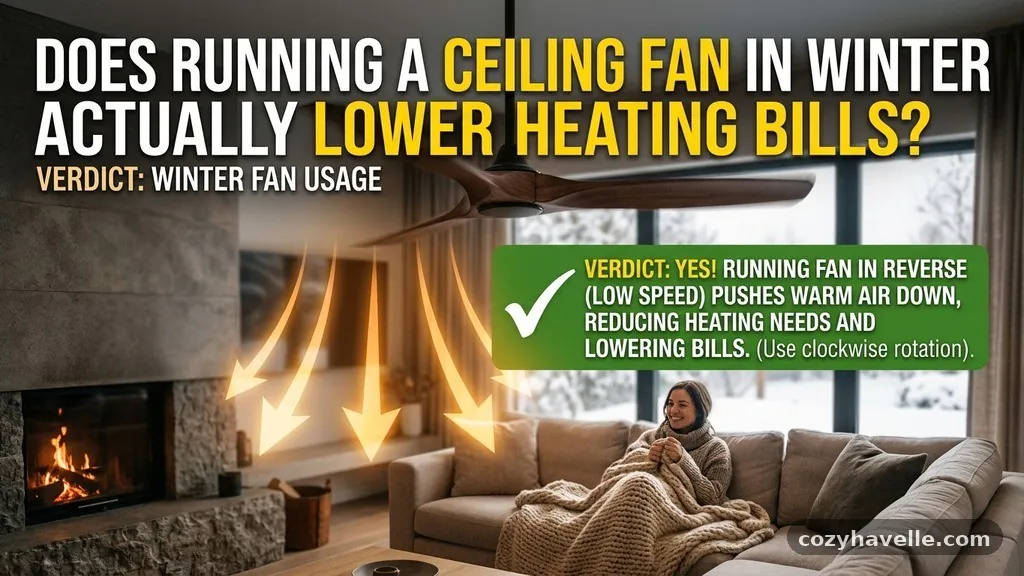
Does running a ceiling fan in winter actually lower heating bills Yes, it can, but only when the unit is switched to the correct rotation and speed. Heat naturally rises, meaning the warmest air in your room often gets trapped near the ceiling, far away from your living space. By reversing the direction of your fan blades, you create an updraft that gently pushes this warm air back down toward the walls and into the floor level.
This process is known as destratification, and it effectively redistributes heat that would otherwise be wasted. You are not generating heat, but you are making the existing warmth more useful.
The energy savings are generally modest rather than transformative. Because you can often lower your thermostat by one or two degrees while maintaining the same level of perceived comfort, you reduce the workload on your furnace or heat pump.
This subtle change is what leads to the reduction in heating costs. Do not expect this technique to replace a high-efficiency heating system or heavy insulation, but it serves as a practical, low-cost supplementary strategy for managing indoor temperatures.
Correcting the Fan Rotation
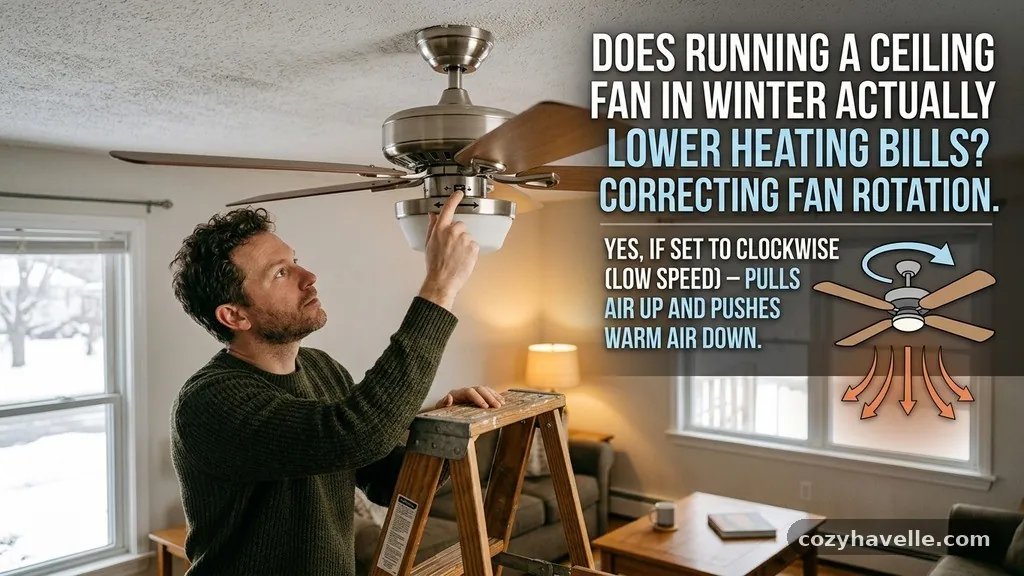
The most critical step in this process is ensuring your ceiling fan is spinning in the right direction. During the summer, you want a downward breeze to create a wind-chill effect that makes you feel cooler. In the winter, that same breeze would make you feel cold and uncomfortable, which is the opposite of your goal.
Most modern fans feature a small toggle switch on the side of the motor housing that reverses the motor’s rotation. When set to the winter position, the blades should spin clockwise at a low speed.
If you are unsure which way your fan is turning, stand directly underneath it and look up while it is running at a low speed. If the air feels like it is being pulled upward or if you feel no breeze at all, you have likely set it correctly for winter.
If you feel a distinct draft blowing down on your face, the fan is still set for summer operation. Changing this direction is a simple manual task that takes only seconds but is the fundamental requirement for any potential energy savings.
The Science of Thermal Destratification
Heat stratification is a physical phenomenon where air organizes itself into layers based on temperature. Hot air is less dense than cold air, so it naturally rises to the highest point in a room. In houses with high ceilings, this can lead to a significant temperature differential between the floor and the ceiling.
The air near your feet might be 68 degrees, while the air near the ceiling could be 80 degrees or higher. This creates a situation where your heating system works hard to warm the space, yet you remain cold.
By using a ceiling fan to pull that warm air down, you level out the temperature gradient. This is the core reason why running a ceiling fan in winter can improve efficiency. When the air at the ceiling is mixed with the air at the floor, the overall room temperature becomes more consistent.
Your thermostat, which is typically mounted on a wall at eye level, will detect this more uniform heat distribution. Consequently, the heating system does not have to cycle on as frequently to maintain your target temperature.
Optimal Speed Settings

When using a ceiling fan during the colder months, speed is just as important as rotation. You want the fan to move air gently without creating a noticeable wind chill. If the fan spins too fast, it will create air currents that move across your skin and evaporate moisture, which makes you feel colder regardless of the actual room temperature.
This defeats the purpose of running the fan to stay warm. Always keep the fan on the lowest possible speed setting during winter operation.
Think of the fan as a mixer rather than a cooler. You are simply trying to blend the air layers to achieve a uniform climate. A slow, steady rotation is sufficient to displace the trapped heat at the ceiling without creating a draft.
If your fan has a wall-mounted speed controller, ensure it is turned down to the minimum setting. If you find that the fan is still creating a draft even on the lowest setting, it may be too large for the room or positioned in a way that disrupts your comfort.
Impact on Your Thermostat
The ultimate goal of using a fan in the winter is to allow for a slight reduction in your thermostat setting. Research from the Department of Energy suggests that adjusting your thermostat by a few degrees can lead to noticeable savings over the course of a long winter.
If your room feels more comfortable because the warm air is being circulated, you can turn your thermostat down by one or two degrees without feeling the difference. This is where the actual financial savings occur.
Every degree you lower your thermostat can save a percentage on your heating bill. While the ceiling fan does consume a small amount of electricity, the cost of running a fan at a low speed is significantly less than the energy required to heat your home by an extra degree.
The math favors this strategy as long as you are careful not to create an uncomfortable breeze. It is a balancing act between the energy used by the fan and the energy saved by the furnace.
Common Mistakes to Avoid

Many people fail to see results because they leave their fans on summer settings throughout the year. If the fan is spinning counter-clockwise in the winter, it will continue to push air down, creating a draft that makes the room feel colder.
This forces people to turn their thermostats up, which increases heating bills rather than lowering them. Always check your fan settings when the seasons change to ensure they match the current requirements.
Another common mistake is leaving the fan running when no one is in the room. Unlike a heater, which needs to maintain a temperature for the structure itself, a fan’s primary benefit in winter is to improve the comfort of the people currently in the room.
If the room is empty, there is no one there to benefit from the destratification. Turning the fan off when you leave the room saves electricity and prevents unnecessary wear and tear on the motor.
Comparing Seasonal Operations
The way you use your ceiling fan changes drastically depending on the time of year. Summer usage is about personal cooling through the wind-chill effect, while winter usage is about thermal management and air circulation.
Understanding this distinction is vital for anyone looking to optimize their home’s energy profile. The following table highlights the differences in how you should configure your fans for these two distinct seasons.
| Feature | Summer Operation | Winter Operation |
|---|---|---|
| Rotation Direction | Counter-Clockwise | Clockwise |
| Speed Setting | Medium to High | Low |
| Primary Goal | Create Wind Chill | Destratify Air |
| Thermostat Adjust | Can turn up (higher) | Can turn down (lower) |
Safety and Maintenance Considerations
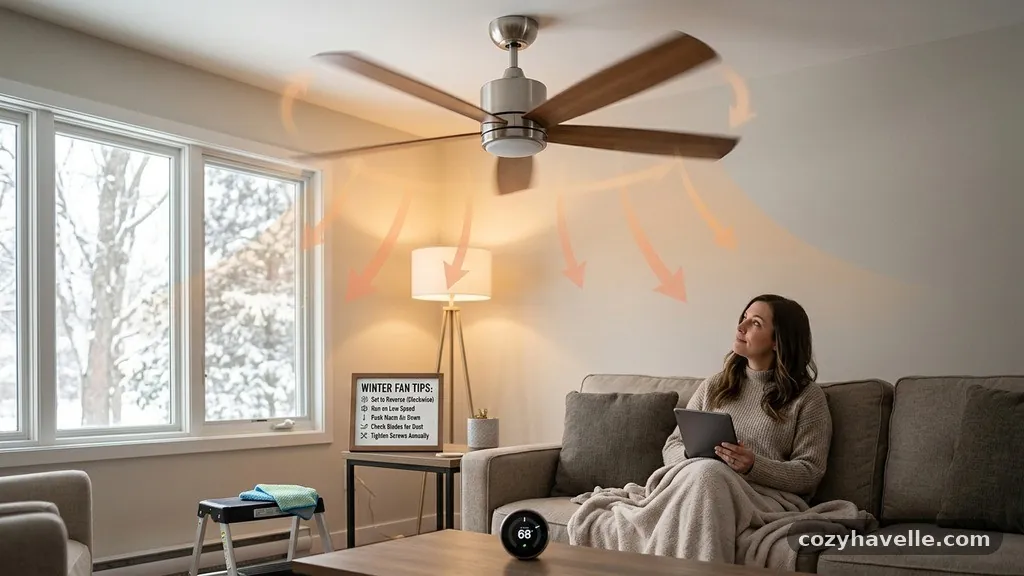
Before you rely on your ceiling fan to help manage your winter heating, ensure the unit is clean and in good working order. Dust buildup on the blades can affect their balance and efficiency, leading to wobbling or noisy operation.
A clean blade moves air more effectively and with less strain on the motor. Use a damp cloth to wipe down the blades at the start of the winter season to ensure the fan performs as intended.
You should also check that the mounting hardware is secure and that the blades are not loose. A wobbling fan is not only inefficient but can also become a safety hazard over time.
If your fan makes clicking or grinding noises, it may be a sign that the motor bearings need attention or that the electrical connections require inspection. Investing a few minutes in maintenance ensures that your efforts to save on heating costs do not lead to unnecessary repairs or safety issues.
When Fans Are Not Effective
There are specific home environments where ceiling fans provide little to no benefit for heating. If you have low, standard-height ceilings, the air stratification is minimal to begin with.
In these rooms, the difference between the floor temperature and the ceiling temperature is likely negligible. Running a fan in a room with an eight-foot ceiling might not yield any real energy savings and could even make the space feel drafty.
Similarly, if your home is poorly insulated or has significant air leaks around windows and doors, the heat loss will far outweigh any benefits provided by a ceiling fan. You should prioritize sealing drafts and improving insulation before relying on secondary methods like fan circulation.
A ceiling fan is a tool for refinement, not a solution for major structural energy losses. If your home is constantly losing heat through the envelope, the fan will not be able to compensate for that loss.
Frequently Asked Questions
Should I leave my ceiling fan on all the time in winter?
No, you should only run the fan when you are present in the room. The fan does not heat the air itself; it only helps redistribute it to improve your personal comfort. Leaving it on in an empty room provides no benefit and unnecessarily consumes electricity.
Is it cheaper to run a ceiling fan or a space heater?
A ceiling fan uses a very small amount of electricity, typically between 10 and 70 watts, compared to a space heater which can use 1,500 watts or more. However, they serve different purposes. The fan helps circulate existing heat, while the heater adds new heat to the room.
Does every ceiling fan have a reverse switch?
Almost all modern ceiling fans have a reverse switch, but it is sometimes located under the light kit or on the side of the motor housing. If you have a very old fan or an industrial model, it might not have this feature, so check your manual or look closely at the unit.
Can I use my ceiling fan with a fireplace?
Yes, using a ceiling fan in winter is particularly effective when you have a fireplace or a wood stove. The fan helps pull the heat generated by the fire down from the ceiling and pushes it toward the floor, helping to distribute the warmth more evenly throughout the room.
Does the color or material of the blades affect performance?
The material and shape of the blades are more important for air movement than the color. While some materials are lighter or more aerodynamic, the primary factor for winter effectiveness is the rotation direction and the speed setting, regardless of the aesthetic design.
Conclusion
Evaluating whether running a ceiling fan in winter actually lower heating bills reveals that while the impact is subtle, the practice is scientifically sound. By reversing the rotation to clockwise and keeping the speed at its lowest setting, you successfully push trapped warm air down into your living space.
This minor adjustment allows you to maintain comfort while lowering your thermostat, ultimately contributing to better energy efficiency. It is a simple, cost-effective habit that complements your existing heating system without requiring significant investment.
Start by checking your fans today to ensure they are ready for the colder months ahead. A quick toggle of the switch can make a noticeable difference in how your home feels during the middle of winter.
As you monitor your energy usage, you will find that small, consistent habits like this contribute to a more comfortable and manageable home environment. If you have questions about your specific fan model, consult the manufacturer’s guide to ensure you are operating it correctly.